The New Page in the HOA Packet That Could Stall a Sherman Oaks Condo Purchase
August 27, 2026
August 27, 2026
A buyer in escrow on a two-bedroom unit off Van Nuys Boulevard does everything right this year. They review the CC&Rs, check the reserve study, confirm dues are current, and remove their contingencies on schedule. Then, a week before closing, their lender's underwriter asks for one more document: proof that the building's balconies passed a state-mandated structural inspection. The HOA cannot produce it. The building never had one done.
This is not a hypothetical edge case. It is the version of due diligence that changed on January 1, 2026, when a new state law quietly rewrote what belongs in every California condo resale packet, and Sherman Oaks, with its stock of older wood-frame buildings from the 1960s and 70s, is exactly the kind of housing stock where the gap shows up.
California has required sellers in a homeowners association to hand buyers a stack of documents under Civil Code Section 4525 for years: governing documents, the annual budget, a reserve study summary, a statement of regular and special assessments, an insurance summary, and board meeting minutes on request. Real estate agents and escrow officers built entire workflows around that list. It felt complete.
It no longer is. Senate Bill 410, effective January 1, 2026, added a new line item to Section 4525: the association's most recent inspection report for exterior elevated elements under Civil Code Section 5551, better known as the balcony and deck inspection law passed after a 2015 balcony collapse in Berkeley. That underlying inspection law, Senate Bill 326, required condo associations statewide to inspect wood-supported balconies, decks, stairways, and walkways more than six feet off the ground by January 1, 2025, with no extension. Apartment landlords got a one-year reprieve under a separate law. Condo HOAs did not.
Industry estimates put statewide non-compliance with that original inspection deadline above one in five associations. That means a meaningful share of the HOA packets circulating in escrow this year will either include the report or include something new instead: a written admission that it does not exist.
Here is what actually changed in the packet a buyer receives:
| Required before January 1, 2026 | Added by SB 410 |
|---|---|
| Governing documents (CC&Rs, bylaws, operating rules) | Unchanged |
| Annual budget report and reserve study summary | Unchanged |
| Assessment and reserve funding disclosure summary | Unchanged |
| Statement of current and pending regular and special assessments | Unchanged |
| Insurance summary | Unchanged |
| Board meeting minutes, last 12 months, upon request | Unchanged |
| Nothing | Most recent Civil Code Section 5551 exterior elevated element inspection report, or a statement that none exists |
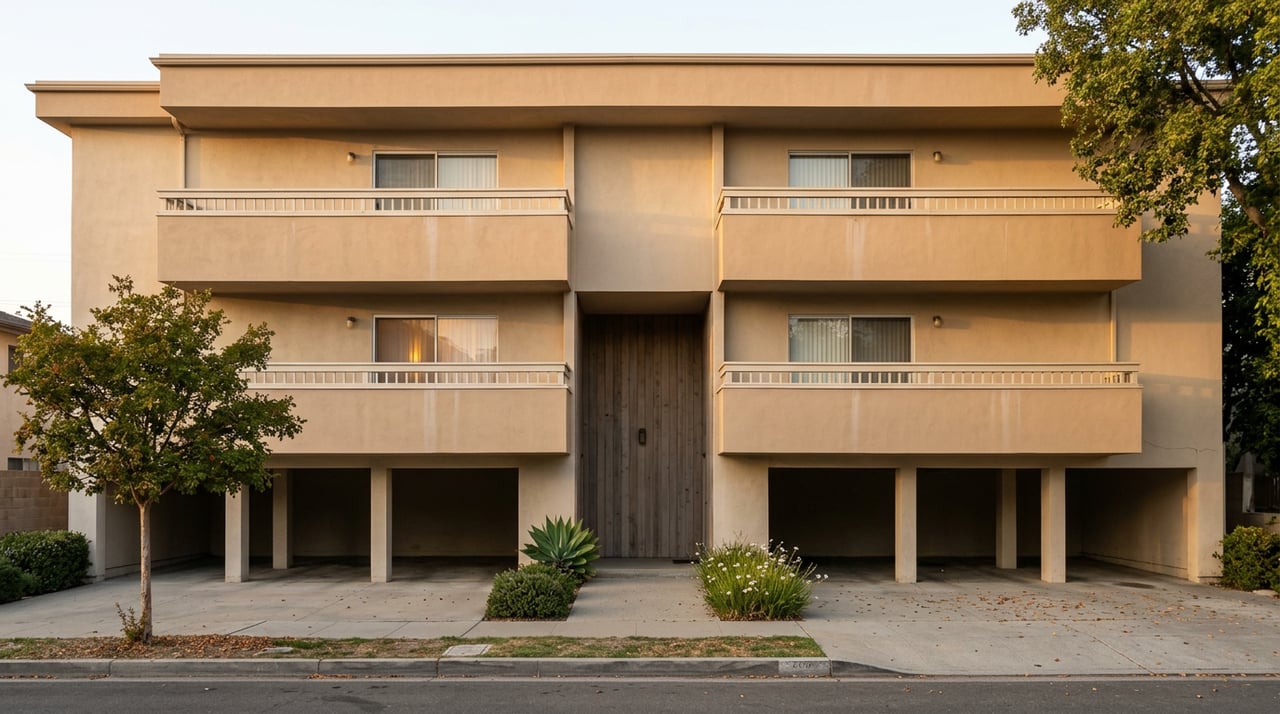
Sherman Oaks sits inside the stretch of the San Fernando Valley that industry reserve-study firms point to as having one of the region's heaviest concentrations of older HOA-governed mid-rise buildings, the kind with shared corridors, subterranean or tuck-under parking, and balconies that qualify squarely under Section 5551. Many of these buildings were framed in wood before 1978, back when tuck-under parking on the ground floor was the cheapest way to add units.
That construction style is also the target of a separate, older law: the City of Los Angeles's mandatory soft-story seismic retrofit ordinance, adopted in 2015 after decades of research into how these buildings perform in an earthquake. The ordinance sorted roughly 13,500 identified buildings into priority tiers. Larger buildings, 16 units and up, had to finish construction by April 2024. Smaller buildings had until April 2026, a deadline that passed just four months ago. A building that missed it does not simply owe a fine. Unpaid penalties and enforcement costs can be recorded as liens against the property, which follow the building through a sale and complicate title and financing for whoever buys next.
This is not an abstract concern for the area. When the Northridge earthquake struck in January 1994, nine single-family hillside houses built on stilts collapsed in Sherman Oaks, part of a broader pattern in which two-thirds of the buildings destroyed or seriously damaged that day were soft-story structures. The state's inspection and retrofit laws exist because of exactly that kind of building.
A missing balcony report or an incomplete retrofit file is not proof of danger. It is proof that a buyer needs to ask a more specific question than "is the packet complete."
Buyers tend to focus on the sticker price of monthly dues and skip past the mechanism that determines how much more they could owe later. California law gives HOA boards real latitude here. Under Civil Code Section 5605(b), a board can levy special assessments totaling up to 5 percent of the association's budgeted gross expenses for the year without a single vote from homeowners.
Picture a 40-unit Sherman Oaks building where dues average $625 a month, in the range of what current listings in the area show. That produces an annual operating and reserve budget of roughly $300,000. Five percent of that is $15,000, spread across the building. Divided evenly, that is about $375 added to each owner's bill, and the board does not need anyone's approval to send the invoice. A larger repair, the kind triggered by a failed balcony inspection or an incomplete seismic retrofit, does not stop at that 5 percent threshold. It requires a membership vote, but boards facing a structural finding rarely have the luxury of waiting for one to unfold slowly.
Assessment liens also survive a sale. A buyer who closes without understanding what is pending inherits the obligation along with the unit.
A buyer working with an agent who understands this year's disclosure rules should ask for these items by name, not assume they are automatically included:
None of this is about walking away from a building. It is about knowing which questions turn a standard 17-day contingency period into real leverage instead of a formality.
The Sherman Oaks condo market has not become riskier this year. The paperwork has become more honest. A packet that once looked complete under the old rules can now legally show a gap, and that gap is information a buyer did not automatically have twelve months ago. Reading it correctly, and knowing what to ask for when it is missing, is the difference between a smooth close and a lender pausing your loan a week before the keys change hands.
What happens if my building's HOA says no balcony inspection report exists? The association still has to disclose that fact under the amended Section 4525. It is not automatically a dealbreaker, but it is a prompt to ask when the inspection will happen, who is scheduling it, and whether the reserve study accounts for likely repair costs once it does.
Does this apply to townhome HOAs, not just high-rise condos? Yes. Civil Code Section 5551 applies to any common interest development with three or more units that has wood-supported balconies, decks, stairways, or walkways more than six feet above ground, regardless of building height.
Is a missing report a reason to cancel a purchase? Not by itself. It is a reason to negotiate, whether that means a price adjustment, a seller credit, or a documented commitment from the HOA on inspection timing before you remove your investigation contingency.
Buying or selling a condo in Sherman Oaks this year means reading a disclosure packet that looks familiar but carries new weight. If you want a second set of eyes on what a specific building's HOA documents actually say before you make a decision, Gary Khachatrian is ready to help. Let's Connect.
Stay up to date on the latest real estate trends.


Experience a level of service defined by discretion, precision, and excellence.