The Burbank Retrofit Deadline Already Passed. Here's What That Means If You're Buying or Selling an Older Apartment Building.
September 24, 2026
September 24, 2026
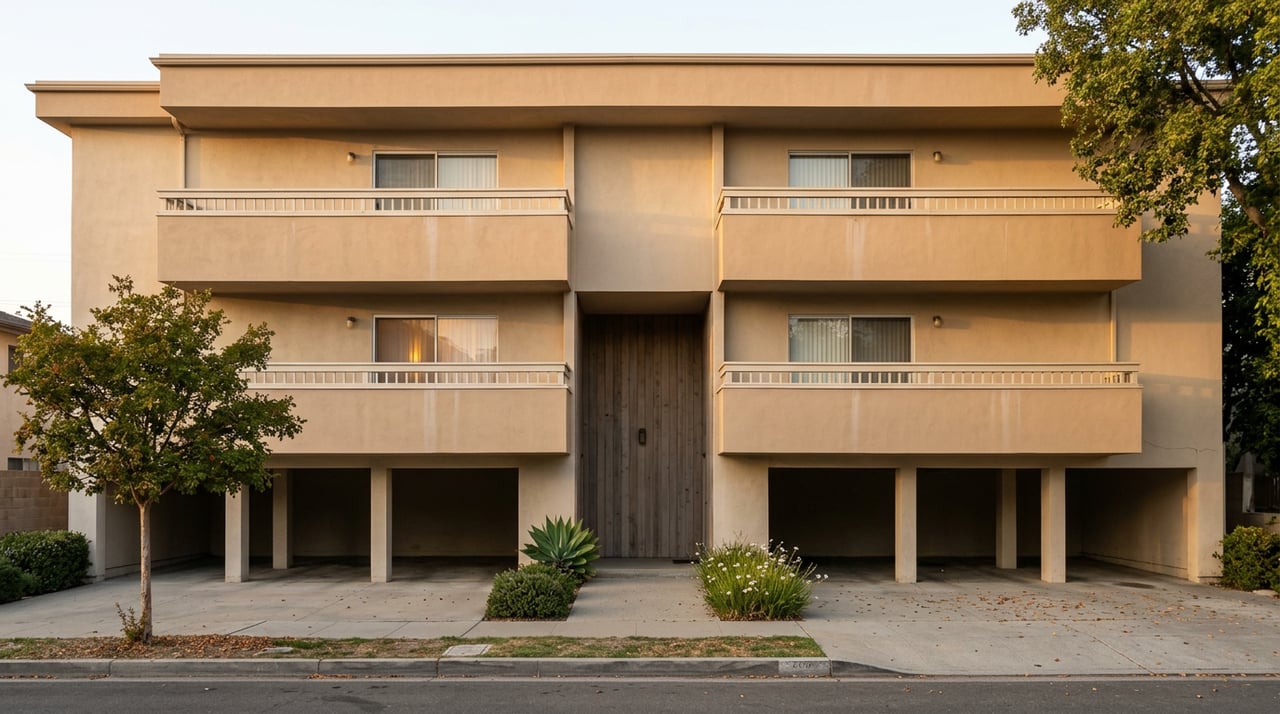
Picture two fourplexes a few blocks apart in Burbank, both built in the early 1970s, both with the same tuck-under parking that made buildings like this so easy to rent and so cheap to build fifty years ago. From the street they look identical. One owner filed a screening form with the city's Building & Safety Division back in January. The other did not. Nothing about the stucco, the parking gate, or the for-sale sign tells you which is which.
That gap is the story right now, not some future retrofit cost. Burbank's Mandatory Soft-Story Seismic Retrofit Ordinance took effect on January 10, 2025, and it set a real calendar with real dates, not a vague future obligation. The first of those dates, the screening form deadline, was January 12, 2026. As of today, that date is eight months behind us. Which means every qualifying building in Burbank has already either complied or fallen out of compliance, and that fact is now sitting in a record somewhere, whether or not it shows up on the listing sheet.
The ordinance targets a specific and identifiable category: wood-frame residential buildings with two or more stories, built under codes in effect before January 1, 1978, with a weak or open first story, most commonly tuck-under parking or garage openings along the ground floor. The city identified roughly 675 properties across Burbank that fit this description when it built the mandatory program, replacing what had been a voluntary retrofit process for years.
If you are looking at a single-family home, this ordinance almost certainly does not apply to you. If you are looking at a small apartment building, a fourplex, or anything with stacked units over ground-floor parking that predates 1978, it is worth checking before you get much further into a deal.
The ordinance did not leave the timeline vague. It laid out five checkpoints, each with a hard date:
| Milestone | Deadline | Status as of September 2026 |
|---|---|---|
| Submit screening form | January 12, 2026 | Passed |
| Submit engineered plans | January 11, 2027 | Upcoming |
| Secure plan approval | January 10, 2028 | Upcoming |
| Obtain building permit | January 10, 2029 | Upcoming |
| Complete construction | January 10, 2030 | Upcoming |
The city also built in a financial incentive for owners who moved fast: a full refund of building permit fees for anyone who completed construction and received final sign-off by July 10, 2026, and a 50 percent refund for anyone who finishes by January 10, 2028. That first refund window has also closed. Given that full completion requires screening, engineering, plan approval, permitting, and finished construction, hitting a July 2026 deadline from a January 2025 start was always going to be a sprint that almost no owner could realistically win. If a seller tells you their building is fully retrofitted and finaled, that claim is worth verifying directly with the city rather than taking at face value, simply because so few buildings could have made that window.
The screening form deadline is the one that matters most for a transaction happening right now. It is binary. A building either has a screening form on file or it does not, and unlike engineering timelines or construction schedules, there is no reasonable excuse left for a building that still hasn't submitted one.
This is the part that changes how a purchase should be handled. Under the ordinance, failure to comply by the specified deadlines results in the building being recorded with the Los Angeles County Recorder as being in violation. That recordation attaches to the property, not to the owner, which means it follows the building through a sale.
Non-compliance also carries a disclosure obligation. Sellers of a qualifying building are expected to disclose its retrofit status to buyers, and separately to tenants if the building is currently occupied. Beyond disclosure, non-compliant status has been shown to complicate financing, since lenders have been known to hesitate on properties carrying a recorded seismic violation, and insurers may add conditions or decline coverage outright.
None of this shows up in a walk-through. It shows up in a title report, a county recorder search, or a direct records request to Burbank's Building Division. That is the practical takeaway for anyone shopping multifamily property here in the second half of 2026: the retrofit clock has already produced a paper trail, and that paper trail is more informative right now than the building's age or its listing photos.
If you are evaluating a pre-1978 apartment building in Burbank with the physical characteristics the ordinance describes, four documents are worth requesting before you get deep into due diligence:
None of this is about walking away from a deal. A building that is behind schedule can still be a sound purchase. But the retrofit obligation is now a known and quantifiable cost, and it belongs in the negotiation the same way a roof replacement or a deferred maintenance list would. The difference is that this particular obligation is enforceable by the city and recorded against the property, which gives it a different weight at the negotiating table than a cosmetic repair.
If you own a qualifying building in Burbank and are thinking about selling, the most useful thing you can do before a listing goes live is close the paperwork gap. If the screening form has not been filed, filing it now, even eight months late, puts a documented starting point in front of buyers instead of an open question. If the form has been filed, having that confirmation ready to hand a buyer's agent on day one removes a source of friction that would otherwise slow escrow while a buyer's lender or title company tracks it down independently.
Sellers who have already engaged a structural engineer, even informally, are also in a stronger position to price the retrofit obligation into their asking price rather than let a buyer's inspector or contractor set that number during negotiations.
The headline fact about this ordinance was always going to be the eventual construction deadline in 2030. But the more useful fact for a transaction happening today is that the early checkpoints have already come and gone, and a building's position relative to those checkpoints is now real, discoverable information rather than a future projection. A buyer who checks screening status before writing an offer knows something about the property that a buyer who only reads the listing description does not. A seller who resolves that status before listing removes a variable that would otherwise surface during someone else's due diligence.
If you are weighing a Burbank multifamily purchase, or you own a building built before 1978 and are trying to figure out where it stands, that is worth a direct conversation before anything goes under contract. You can also see what similar properties in the area are currently listed at on our Burbank neighborhood page, and if you want a clearer read on what your building might be worth with its current compliance status factored in, our home valuation tool is a reasonable starting point. For the ordinance details themselves, the City of Burbank's Building & Safety Division page lays out the screening form and the full compliance schedule directly.
Does this ordinance apply to a duplex? The mandatory program applies to qualifying wood-frame buildings with the specified soft-story characteristics. Building size and unit count affect which compliance group a property falls into, so a duplex should be evaluated against the specific criteria rather than assumed to be exempt or included.
If I buy a non-compliant building, do I inherit the retrofit obligation? The compliance timeline and any recorded violation attach to the property. A new owner generally steps into the same obligations the previous owner had, which is exactly why confirming status before closing matters more than it would for a purely cosmetic issue.
Is the 50 percent permit fee refund still available? As of today, the deadline to complete construction and finalize permits for the 50 percent refund is January 10, 2028, which remains open. The earlier 100 percent refund deadline of July 10, 2026 has already passed.
Questions about a specific Burbank property, whether you are buying, selling, or holding one of these buildings, are worth a direct conversation rather than a guess. Gary Khachatrian is available to walk through what a building's compliance status actually means for your timeline and your price. Let's Connect.
Stay up to date on the latest real estate trends.
Experience a level of service defined by discretion, precision, and excellence.